Acoustics & Aesthetics: The Connoisseur’s Guide to Integrated Home Theater Design
Here’s a fact that surprises many homeowners: you can spend over $50,000 on the world’s best audio-visual equipment and end up with a listening experience that’s worse than a standard soundbar. Why? Because the room itself is the most critical, and most often ignored, component of any high-performance home theater. The most powerful speakers and vibrant projector are rendered mediocre by poor acoustics and distracting design. For those seeking an ultra-premium basement finishing experience, creating a truly immersive space is a masterful blend of science and art—where acoustic performance and aesthetic beauty become one.
Beyond the Big Screen: Why Room Acoustics are Your Theater’s Unsung Hero
When you imagine a home theater, you probably picture a massive screen and plush, comfortable seating. But what about the sound? In a poorly designed room, sound waves bounce uncontrollably off hard surfaces like drywall, glass, and hardwood floors. This creates a chaotic mess of echoes, reverbs, and frequency imbalances that muddy dialogue, flatten explosions, and ruin the cinematic soundscape the director intended. Experts in basement finishing consistently find that controlling this chaos is the first step to achieving audio excellence.
We’re talking about managing three key acoustic principles:
- Absorption: This is the process of taming sound reflections. Think of it like putting a sponge in a puddle. Materials like thick carpeting, acoustic wall panels, and even heavy draperies absorb sound energy, preventing it from bouncing around the room and causing echo (also known as flutter echo). A common situation we encounter is a client with a beautiful new theater who finds dialogue hard to understand—this is almost always due to a lack of absorption.
- Diffusion: While absorption kills reflections, diffusion scatters them. Instead of a single, harsh echo, a diffuser breaks up the sound wave into many smaller, less noticeable reflections. This is crucial for creating a sense of spaciousness and envelopment, making the room feel larger and the soundstage more three-dimensional. Wood slats, custom-built quadratic diffusers, and even strategically placed bookshelves can act as effective diffusers.
- Bass Management: Low-frequency sound waves (bass) are the trickiest to control. They are long and powerful, tending to build up in corners and create “boomy” or “muddy” spots in the room. This is where specialized bass traps, often hidden in the corners of the room, become essential. Proper bass management ensures that every explosion and musical score note is felt with tight, articulate impact, not just heard as a vague rumble.
The Art of Invisibility: Seamlessly Integrating Technology with Design
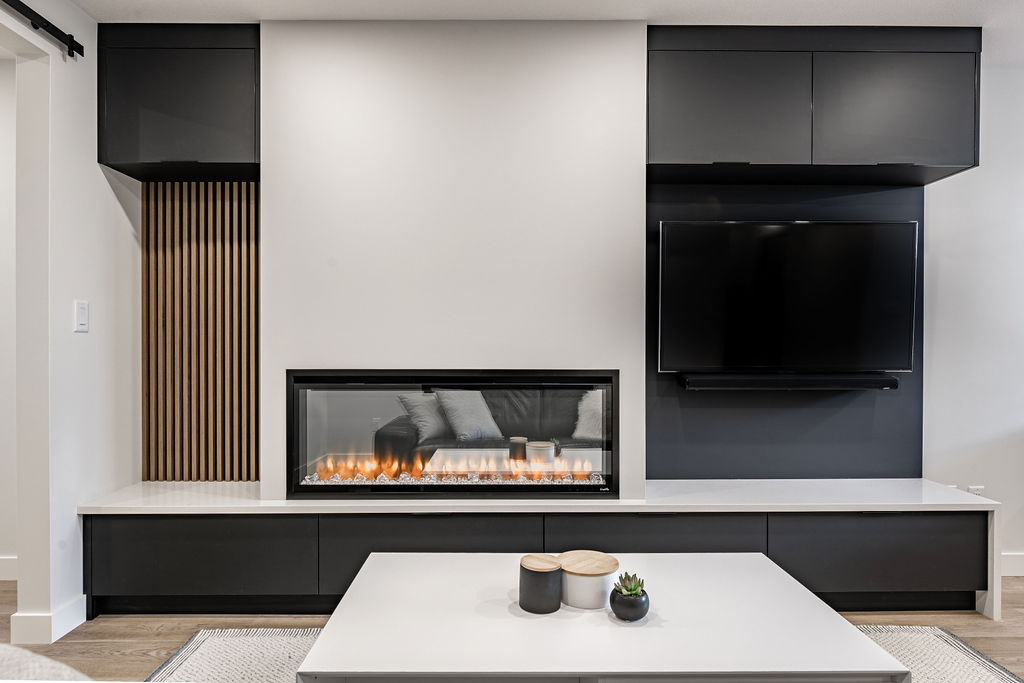
A truly high-end home theater doesn’t look like an electronics store. The goal of premium basement design is to make the technology disappear, leaving only the immersive experience. The clutter of wires, bulky black boxes, and obtrusive speakers can completely undermine a carefully crafted aesthetic. This is where custom basement development truly shines, allowing for integration that is planned from the very first framing stud.
Industry professionals recommend several key strategies for achieving this technological sleight of hand:
- Concealed Speakers: The days of massive tower speakers flanking the screen are fading for a clean, integrated look. High-performance in-wall and in-ceiling speakers can be installed flush with the drywall and even painted to match, becoming sonically powerful yet visually invisible. For the ultimate connoisseur, behind-the-screen “acoustically transparent” screens allow for the front channel speakers to be placed directly behind the image, just like in a commercial cinema.
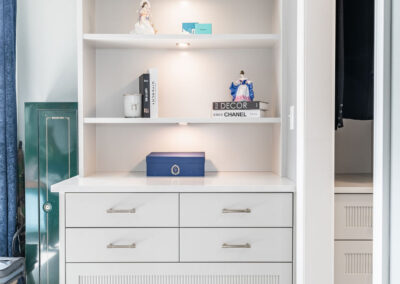
- Centralized Equipment: Instead of a messy stack of components under the screen, imagine all your equipment—AV receiver, amplifiers, media players—housed in a dedicated, ventilated closet or custom-built cabinetry. This not only cleans up the look of the room but also eliminates distracting fan noise and blinking lights.
- Thoughtful Lighting Control: Lighting is more than just illumination; it’s a critical part of the experience. A professional design incorporates multiple layers of light—pot lights, sconces, floor-level accent lighting—all controlled by a smart system. With one button press, the lights can dim to the perfect movie-watching level as the projector turns on, creating a seamless transition into the cinematic world.
If you’re struggling to envision how to hide the technology without sacrificing performance in your unfinished basement, this is the perfect time to seek professional guidance. Axium Interiors can help evaluate your specific situation and design a seamless integration plan.
Soundproofing vs. Acoustic Treatment: A Crucial Distinction for Saskatoon Homes
Clients often use the terms “soundproofing” and “acoustic treatment” interchangeably, but they are two very different concepts. Understanding the distinction is vital for a successful project, especially when building a basement suite or theater here in Saskatoon.
- Soundproofing is about isolation. Its purpose is to prevent sound from leaving the theater and disturbing the rest of the house, or to stop noise from the furnace room or upstairs from getting in. This involves construction techniques like building a “room within a room,” using specialized drywall (like QuietRock), adding mass-loaded vinyl, and sealing every possible air gap with acoustic caulk.
- Acoustic Treatment is about quality. Its purpose is to control how sound behaves *inside* the room to provide clarity, detail, and immersion. This is achieved using the absorption and diffusion panels we discussed earlier.
A typical scenario for Saskatoon families is wanting to enjoy a late-night action movie without waking the kids sleeping upstairs. This requires effective soundproofing. But to ensure that the movie’s dialogue is intelligible and the surround sound effects are precise, you need effective acoustic treatment. A premium basement development project addresses both, creating a private cinematic oasis that coexists peacefully with the rest of your home.
Material Matters: Choosing Surfaces for Sonic and Visual Harmony
Every single surface in your home theater has an impact on both its look and its sound. A high-end basement contractor doesn’t just choose materials based on aesthetics; they select them for their acoustic properties. This holistic approach ensures the room performs as beautifully as it looks.
Consider these critical choices:
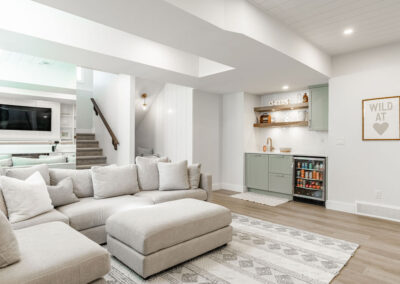
- Flooring: This is one of the biggest surfaces in the room. Hard surfaces like tile, laminate, or concrete are an acoustic nightmare, creating harsh reflections. Wall-to-wall, high-pile carpeting with a quality underpad is the industry standard for a reason. It’s a fantastic sound absorber, especially for higher frequencies, and adds a luxurious, comfortable feel. If you must have a hard surface for a portion of the room (like a bar area), large, thick area rugs are essential.
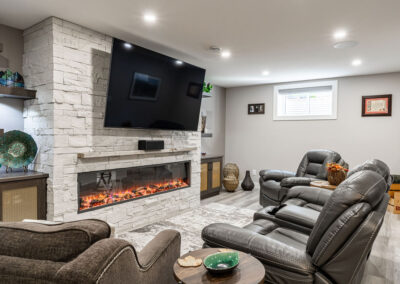
- Seating: Your theater seating is more than just a place to sit; it’s a major piece of acoustic furniture. Large, plush, fabric-covered recliners are excellent because they absorb sound. Leather seating, while looking sleek, is more reflective and can cause unwanted acoustic glare. The placement of the seating is also critical—it should be away from the walls in the acoustically “sweet spot” of the room.
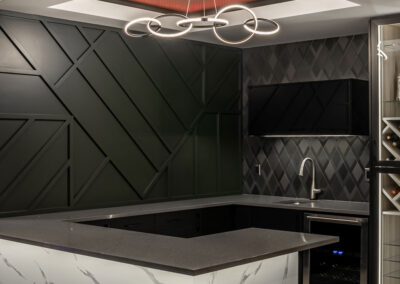
- Walls & Ceiling: The goal is to avoid parallel, reflective surfaces. A combination of absorption panels, diffusers, and non-reflective paint (like a flat or matte finish in a dark color) is ideal. An insider tip: painting the ceiling a dark, non-reflective color not only helps with picture contrast by absorbing stray light from the screen but also makes the ceiling seem to disappear, enhancing immersion. For a truly premium basement design, fabric-wrapped acoustic wall systems can hide all the treatments for a clean, elegant “designer” look.
The ‘Saskatoon Scenario’: Designing for Our Unique Basements
Finishing a basement in the Saskatoon area presents its own unique set of challenges and opportunities. Our climate, soil conditions, and typical home construction mean that a successful basement renovation requires local expertise.
When planning a custom basement finishing project for a home theater, Saskatoon-based professionals pay close attention to:
- Moisture Management: Before any framing goes up, managing potential moisture is priority number one. This means a thorough inspection of the concrete foundation for cracks, proper installation of a high-quality dimpled membrane subfloor, and ensuring the vapor barrier is meticulously sealed. These steps are non-negotiable for protecting your significant investment in electronics and finishes.
- Working with Concrete: Concrete is highly reflective of sound. Directly attaching drywall to concrete foundation walls is a common mistake that leads to poor acoustics and potential moisture problems. Proper framing with an air gap, appropriate insulation, and then the soundproofing layers are key to turning a concrete box into a comfortable, high-performance space.
- Ductwork and Mechanicals: Basements are the hub for your home’s HVAC systems. Boxing in ductwork is standard, but for a home theater, it’s crucial to insulate that ductwork to prevent noise transmission and to ensure the bulkhead itself doesn’t vibrate and resonate with low-frequency sounds.
Whether you have a deep walk-out basement with plenty of light or a more traditional layout, a Saskatoon basement renovation specialist can turn these local characteristics into advantages for your dream theater. For professional guidance on navigating the specifics of your space, connect with the Axium Interiors team today.
Local Expert FAQ
Do I need a special permit for a home theater in Saskatoon?
Generally, finishing your basement for a media room falls under a standard basement development permit. However, if your plans involve significant structural changes, extensive new electrical wiring for high-power components, or plumbing for a wet bar, specific permits are required. If you are considering adding a full bathroom or kitchen components, you might be approaching the requirements for a legal basement suite in Saskatoon, which has a separate and more stringent set of regulations. It’s always best to consult with a professional contractor who is familiar with local building codes.
What’s the biggest mistake homeowners make when designing a media room?
The most common and costly mistake is focusing 100% of the budget on the electronics and 0% on the room itself. As we’ve discussed, the room’s acoustics and layout are paramount. Another frequent error is improper speaker placement. Simply placing speakers where they fit aesthetically, rather than where they create the optimal soundstage, can cripple the performance of even the most expensive system. Following industry standards for speaker angles and distances from the listening position is critical.
How can I ‘future-proof’ my home theater?
Technology changes rapidly. The best way to future-proof is to focus on the infrastructure. The most important tip is to run conduit. Installing empty pipes (conduit) from your equipment rack to your projector location and key speaker points makes it dramatically easier to pull new types of cables in the future (e.g., the next generation of HDMI or fiber optic cables) without tearing open walls. Also, planning for more speaker locations than you initially need (for example, wiring for extra height channels for future audio formats) is a smart, relatively low-cost investment during the construction phase.
Key Takeaways
- The room itself is the most important component in your home theater system, influencing sound quality more than the electronics.
- Great audio requires a balance of absorption (to kill echo) and diffusion (to create spaciousness).
- Soundproofing (isolation) is different from acoustic treatment (quality). A premium theater needs both.
- Seamlessly integrating technology by concealing speakers, wiring, and equipment is key to a high-end aesthetic.
- Every material choice, from carpet to seating fabric, impacts the room’s acoustic performance.
- Basement development in Saskatoon requires specific attention to moisture control and proper insulation around concrete foundations.
- Planning for the future by running conduit is the single best way to ensure your theater can evolve with technology.
Disclaimer: While we aim for accuracy, please verify details for your specific situation. For personalized advice and to discuss how these insights apply to your specific needs, we would love to chat with you directly.
Your Ultimate Cinema Awaits
Designing an integrated home theater is a complex symphony of details where physics and interior design must work in perfect harmony. It requires more than just buying expensive gear; it demands a deep understanding of how sound and light behave in a space. Don’t leave your dream of the ultimate cinematic experience to chance. The difference between a good media room and an unforgettable private cinema lies in professional planning and execution.
If you’re ready to transform your unfinished basement into a